U.S. government
The TommyknockersThe U.S. government is presented less through direct officials than through the expectations and fears it inspires: the prospect of a buried spacecraft turns eminent domain, military custody, secrecy, and enforced isolation into immediate possibilities. Its imagined response forces Jim Gardener and Bobbi Anderson to confront whether the ship is a local discovery, a threat to the town, or a resource whose fate belongs to the wider world; later, the National Guard’s cordon around Haven gives that anticipated power a visible form.
The anticipated takeover
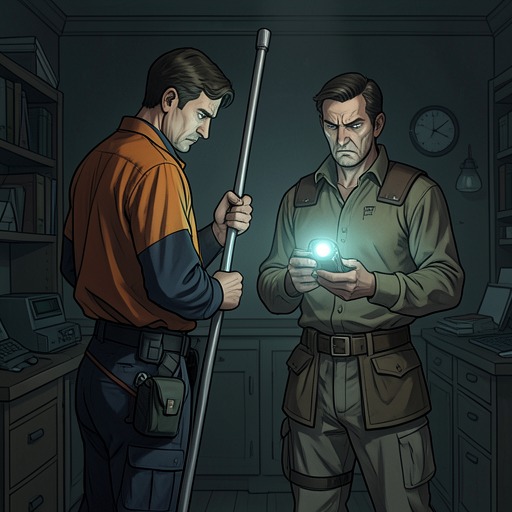
When Gardener recommends calling Limestone Air Force Base about the unidentified object on Anderson’s land, Anderson rejects the idea that private ownership would protect her. She points to eminent domain as a means by which the U.S. government can take land for public projects, including turnpikes and nuclear reactors. Her forecast is precise: within three days, neither the property nor the ship would still be hers; within six days, guards and barbed wire would surround the site; within six weeks, she thinks, most of Haven’s population could be bought out, driven away, or simply lost.
Anderson’s fear is not merely that officials would take possession of an artifact. The object is already producing extraordinary effects: she has managed to power her house with D-cells, and Gardener suspects that the machinery on the Tomcat may soon work as well. The ship’s influence appears capable of turning proximity into technical knowledge, making Anderson herself part of what the government would want to control. Gardener’s imagined outcome is correspondingly darker than a polite consultation: the discoverers could be gagged or confined somewhere resembling a gulag disguised as a resort. The joke about beads being free only sharpens the underlying prospect that they might never get out.
Anderson translates Gardener’s proposal into a deliberately absurd vision of official courtesy. She imagines the Joint Chiefs seeking advice from a writer because she owns the land, and the President inviting her to the White House to discuss her novel. The mock invitation exposes the mismatch between the imagined honor of being consulted and the power imbalance she expects in practice. In her view, the government would not treat her as an expert or a landowner whose consent matters; it would take control of the discovery.
Gardener’s change of scale
The argument unsettles Gardener because it makes his own political instincts part of the problem. He has opposed government and nuclear power, including arrest at Seabrook with a gun in his pack, and initially wants the Air Force involved. Yet as he replays the conversation, he recognizes that the ship cannot be judged only by Anderson’s welfare or Haven’s. Its eventual disposition, he concludes, must be considered in terms of the world’s welfare.
That responsibility has a personal edge. Gardener has taken part in committees and demonstrations, supported causes, and contributed to unsuccessful efforts to close Maine Yankee, but his political action has generally been collective. Now he faces a decision that cannot be handed off to a group. His pause is not a simple conversion to trust in government: he still understands why Anderson fears official seizure, and his earlier advice has already been undercut by his suspicions about how power works.
The ship’s possible benefits make the choice harder. Gardener imagines its energy as clean, abundant, cheap, and easy to produce: within six months, he thinks, every U.S. reactor might be shut down, and within a year, every reactor in the world. Cheap transport and travel to other planets or star systems also seem possible. The vision is sweeping, but it rests on a concrete observation: the ship reached Haven by means other than an ordinary vessel, and its technology is already changing what Anderson can build.
The promise does not settle the question. Gardener wonders whether the ship contains weapons, and whether the same residual force that has enabled Anderson’s devices could be turned toward a stun gun, disintegrator, or other destructive technology. Even if the ship itself has no weapons, its principles might be adapted. The possibility of liberating the world from nuclear power therefore arrives inseparably from the possibility of creating new means to harm people. Gardener’s recognition of the ship as a potential answer to everything is immediately shadowed by the question of who could wield it.
Haven, secrecy, and barriers
The story’s later crises make the question of state power inseparable from the control of movement and information. During the hot spell from July 12 through July 19, Anderson’s old truck, rebuilt as a digging machine, can be heard in Haven Village as work continues at the old Frank Garrick place. Residents know something important is happening, but do not discuss it openly. Meanwhile, Justin Hurd’s becoming has led him to build a harmonic-wave machine that could trigger a devastating earthquake. Beach Jernigan dismantles it while Hurd is away, an act of local intervention intended to prevent a danger that the town’s ordinary routines conceal.
When Ruth McCausland tries to leave Haven, the possibility that the town has been enclosed first seems irrational. The evidence around her appears ordinary: traffic passes, including a chicken truck and a car driven by Nancy Voss. But when Ruth continues along the road, the air grows springy and resists her body, pressing against her until her feet slip backward. The invisible boundary turns geography into a mechanism of confinement. The scene does not show the U.S. government creating that barrier; rather, it establishes that Haven is already a place where crossing the boundary can become physically impossible, complicating any simple contrast between local control and outside intervention.
From forecast to cordon
The anticipated government takeover is not the same event as the later military quarantine. By nightfall, the Maine National Guard has cut Haven off from the outside world, with Guardsmen downwind wearing oxygen equipment. The cordon responds to a disaster whose lethal air has already produced hundreds of unofficial reports and sightings of a gigantic UFO rising from the smoke in Big Injun Woods. It makes containment visible while also showing how incomplete official knowledge is: the first official account of conditions in Haven comes from two men who have walked out of the polluted area, not from a controlled understanding of what has happened inside.
Torgeson and Weems escape on foot after their cruiser becomes unusable. Sharing the oxygen in their last flat-pack, they reach Troy and find that they can breathe the outside air. Weems emerges with a bloody nose; Torgeson has lost several teeth. Their survival depends on the wind and on reaching the edge of what government reports will later call the zone of pollution. The National Guard’s perimeter thus marks a boundary of danger as well as a boundary of state control.
The U.S. government’s place in the novel is defined by this tension between the scale of the problem and the means available to manage it. Anderson fears that official protection of a world-changing discovery would become dispossession and enforced silence. Gardener sees why the ship cannot be treated as a private possession, yet fears that its immense benefits may produce an even greater capacity for violence. When the National Guard finally surrounds Haven, the state acts on the visible emergency by sealing the town off; that action does not resolve the earlier question of who should control the ship or whether control can keep its power from becoming another danger.